


Cat Coffee Shop

Tomodachi Life: Living the Dream

Joy Pony

Game of Farmers

Life The Game

Good Coffee, Great Coffee

Cinema Simulator






















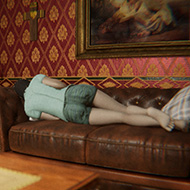
That’s Not My Mom! looks like a short walk home from school, but every return trip asks the same quiet question: does she still look like your mother, or has something replaced her while you weren’t watching?
| Genre | Anomaly Horror |
| Developer | Solitary Studios |
| Playable Character | A young elementary school boy |
| Platform | PC |
| Inspired By | Twisted Gallery and Exit 8 |
The structure of That’s Not My Mom! isn’t built around separate levels — it’s built around days. Each one sends you home to the same house, and each one usually hides a new anomaly somewhere in it: a missing picture frame, a duplicated piece of furniture, an object that’s rotated slightly from where it sat the day before. The first day exists mostly to let you memorize the house’s normal layout, which turns out to matter more than almost anything else the game gives you.
Later days start moving the anomalies onto your mother herself rather than the environment around her, and that’s usually the point where new players stop treating the game like a spot-the-difference puzzle and start treating it like something closer to a survival check. By the time the game introduces its first full pursuit sequence, players who’ve been sloppy about memorizing earlier days tend to pay for it immediately.
Players moving efficiently through the house on a familiar route find comparisons easier, since viewing each room from the same angle every time makes subtle changes stand out that a wandering playthrough would likely miss entirely.
The game’s central tension comes from a simple, uncomfortable premise: you’re being asked to treat your own mother as a potential threat. Her position in the house, her behavior, and even her physical form can shift without warning, and the game leans into that discomfort rather than softening it — this is explicitly a story about a young boy trying to determine whether the woman in front of him is still the person she’s supposed to be.
Reviews describe That’s Not My Mom! as tense and gripping rather than outright terrifying, and that distinction matters for setting expectations. It’s not chasing constant jump scares; it’s building unease through repetition and the growing suspicion that something in the house has already changed before you’ve noticed it.
Some players lean toward rushing through each day to reach the anomaly faster, while more cautious players deliberately slow down and re-check rooms they’ve already passed, and both approaches surface different details the game rewards depending on which anomaly is active that day.
What happens inside the house isn’t presented as an isolated event. Similar anomalies are described as appearing elsewhere in the city, which gives the day-by-day structure a larger mystery to build toward rather than leaving each visit feeling disconnected from the next. The game never over-explains this outbreak, which keeps the focus tightly on the house itself while still suggesting a bigger picture the player only glimpses in fragments.
By the time you reach the later days and the game starts introducing transformed versions of the mother figure alongside its first real chase sequences, the earlier environmental anomalies feel almost quaint by comparison — a deliberate escalation that most players point to as the moment the game commits fully to horror rather than observation.
Community vocabulary around the game tends to borrow directly from the “anomaly game” genre it draws from, with players describing runs in terms of how many anomalies they caught versus missed on a given day, much the way fans of Exit 8 track clean loops.
Not every review is glowing, and the most common criticism is refreshingly specific: several players have flagged serious performance issues, describing framerates that feel far lower than the number displayed on screen even at settings that should run smoothly. It’s a fair critique of an otherwise well-regarded game, and one the developer would need to address for players judging it purely on technical polish.
Even with that caveat, the reception has stayed largely positive, with players consistently praising how effectively a short, modestly scoped project builds dread out of something as ordinary as walking through a familiar house.
The main story runs across 23 days, each representing another return home from school, with the difficulty and strangeness of the anomalies escalating as the days go on toward a final sequence and ending scene.
Large, obvious features first — furniture placement, missing frames, and duplicated objects — before moving on to smaller details like picture contents, item counts, and object orientation, since the game doesn’t always highlight what’s actually different.
It’s a smaller side project developed alongside Solitary Studios’ main title, sharing the studio rather than the story, and built specifically as a short, focused anomaly experience rather than a continuation of that larger game.
Whether you’re chasing a clean run across all 23 days or just trying to make it home without setting off a chase sequence, That’s Not My Mom! keeps the tension anchored to one unsettling question about the woman waiting in that house.