


Cat Coffee Shop

Tomodachi Life: Living the Dream

Joy Pony

Game of Farmers

Life The Game

Good Coffee, Great Coffee

Cinema Simulator















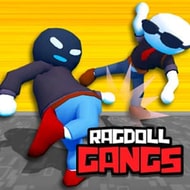






Ragdoll Gangs looks like a lightweight browser brawler you’ll master in ten minutes, but it plays like a physics experiment that occasionally kills your combo by accident. You throw a punch, your opponent’s ragdoll body absorbs it at an angle nobody designed on purpose, and suddenly the fight you thought you had won turns into a scramble.
| Genre | Physics brawler |
| Platform | Browser |
| Modes | Adventure (6 levels), Arena (3-round matches vs CPU or a friend) |
| Controls | WASD move, mouse view, C pick up, V punch, B kick, Shift run |
Adventure mode runs you through six levels, each built around a different objective rather than a straight repeat of “beat everyone up.” Some stages have you clearing waves of street enemies with nothing but your fists, others task you with throwing opponents off a rooftop instead of just knocking their health down, and at least one level asks you to trap enemies inside a cage rather than defeating them outright. That variety is what keeps Adventure mode from feeling like the same fight six times in a row.
Beginners often treat every level like the wave-clearing ones, throwing punches at anything that moves. That falls apart fast on the rooftop-throw level, where brute-forcing damage matters less than positioning an opponent near the edge and timing a shove. Reading the level’s actual goal before engaging saves a lot of wasted attempts.
Difficulty in Adventure mode climbs less through tougher enemy stats and more through objective complexity. Early levels forgive sloppy positioning; later ones punish it, especially once cage-trapping and precision throws come into play instead of straightforward brawling.
Arena strips away the level objectives and puts you in straight one-on-one duels against the CPU or a second player on the same setup. Each match runs three rounds, health resets between them, and power-ups scattered around the stage — a spear, a pair of axes, a stick — become the deciding factor more often than raw punch-and-kick exchanges.
Community discussion around Arena mode tends to focus on combo timing versus panic-picking-up-whatever’s-nearby. Players chasing a clean 3-0 sweep usually commit to a weapon strategy from round one rather than reacting purely on instinct, since scrambling for a spear mid-swing often leaves an opening the opponent capitalizes on.
Choosing a fighter in Ragdoll Gangs means picking from ten avatar designs — Viking, Soldier, Assassin, Thief, Librarian, Knight, Robin Hood, Samurai, Hipster, and Superheroine. None of them change the underlying ragdoll physics, so the choice is purely cosmetic, but plenty of players still gravitate toward a specific avatar and stick with it across sessions simply because it makes the chaos feel more personal.
Rocks and trash bins are the improvised options you’ll find scattered around city-street levels in Adventure mode, useful for a quick ranged hit before an enemy closes the distance. The spear and the two axes show up specifically as Arena mode power-ups, hitting harder than fists but requiring you to commit to melee range once you’ve picked one up. The stick rounds out the Arena power-up set as the fastest-swinging option, trading raw damage for speed. Surprise boxes scattered across both modes contain a randomized mix of these, so you rarely know exactly what you’re grabbing until it’s already in your hands.
WASD handles movement, the mouse controls your view, C picks items up, V throws a punch, B delivers a kick, and Shift lets you run. On paper that’s a standard control scheme, but Ragdoll Gangs’ physics make execution messier than the inputs suggest — a punch thrown mid-run can send your own character stumbling as much as it staggers the opponent, since ragdoll limbs don’t always cooperate with precise timing.
This is the part of the game most divisive in player discussion. Some love the unpredictability as the whole point of a ragdoll brawler; others find it frustrating when a clean combo gets undone by physics rather than an opponent’s actual skill. Both reactions are fair, and it’s worth going in expecting the physics to occasionally work against you rather than always for you.
The rooftop level deserves specific mention because it inverts the usual win condition. Instead of reducing an opponent’s health to zero, you’re maneuvering them toward the edge and using a throw to knock them off entirely. It’s a level that trips up players who arrive expecting a standard slugfest, since pure punching accomplishes less here than smart positioning.
Later in Adventure mode, at least one level shifts the objective to trapping enemies inside cages rather than fighting them down directly, which forces a completely different approach to crowd control than the early wave-clearing stages use.
Between the rooftop throws, the cage traps, and the sheer unpredictability of ragdoll limbs mid-punch, Ragdoll Gangs earns its replay value by never quite letting a fight go exactly the way you planned — pick your Samurai or your Librarian, grab a stick before the spear’s gone, and expect the physics to have the final say.