


Cat Coffee Shop
Tomodachi Life: Living the Dream

Joy Pony

Game of Farmers

Life The Game

Good Coffee, Great Coffee

Cinema Simulator


















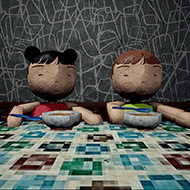

Family Secrets 1: Empty Plate looks like a quiet babysitting story but plays like a slow unraveling of everything that story is supposed to protect. Miko gets a phone call from his mother saying she’ll be away for work, and from that ordinary setup the game builds something much harder to sit through, using the small scale of a single house to make the horror feel uncomfortably close rather than distant.
| Genre | Psychological horror |
| Perspective | First person, walking simulator |
| Main characters | Miko, Jun |
| Combat | None |
With their mother gone, Miko becomes the one holding the household together, and the game keeps that responsibility as its emotional center rather than treating it as a side objective. Jun, his younger sibling, depends on him for food and comfort, and small domestic tasks — checking on Jun, looking for something to eat, responding to whatever a given room brings up — make up most of what the player actually does. There’s no objective marker pushing you toward the next scripted beat; the house itself, and Jun’s needs inside it, are what steer the pacing.
A letter from the electrical company arrives partway through the story, a small detail players bring up often because it quietly confirms just how much financial strain sits underneath the family’s situation before anything overtly frightening happens. That letter functions as one of the clearest pieces of environmental storytelling in the whole game, since nobody explains it directly — you’re expected to connect it to the family’s circumstances on your own the same way Miko would.
There are no weapons, no health bar, no enemies to fight. Family Secrets 1: Empty Plate keeps its horror rooted in neglect and silence rather than in threat, which is part of why players who came in expecting a more traditional horror structure sometimes describe the early minutes as slow before the tone fully commits to what kind of game this actually is.
Later in the game, an ordinary hide-and-seek session between Miko and Jun becomes the sequence most players point to as the moment everything shifts. The mechanics don’t change at all — it’s still movement and observation — but the framing of a normally playful activity turning unsettling is where the game’s tone tips hardest toward direct horror rather than slow dread, and clips of that specific scene are what circulate most widely whenever the game gets shared online.
Jun’s nightmares recur around this point too, tied to a recurring dream figure named Soso who appears to guide Jun’s choices after waking, which players interpret as one of the clearest signs that something beyond ordinary neglect is happening in the house. The bedtime-story loop Miko relies on to calm Jun down starts failing more often once Soso becomes a recurring presence, and several players describe that shift — a comfort mechanic slowly stopping working — as more unsettling than any single scare in the game.
Story-focused players respond strongly to this stretch specifically because the horror stays grounded in the siblings’ relationship instead of escalating into something external, while players more drawn to atmosphere and visual design tend to linger on how the claymation-adjacent art style makes Jun’s nightmare sequences feel deliberately off in a way sharper, more realistic visuals wouldn’t achieve as effectively.
It’s built as a short, linear experience meant to be completed in one sitting rather than a game with chapters or a large map, which is consistent with how the narrative is structured around a single household over just a few in-story days. Most playthroughs stay tightly focused on that one home, with no second location waiting behind a loading screen.
The game is openly inspired by that earlier title’s premise and claymation-adjacent visual style, though BADCAT Games built an original story around Miko and Jun rather than continuing someone else’s narrative directly. Several players who came in expecting a direct sequel have noted the disappointment of that distinction in comments, even while praising how the new story stands on its own.
No combat and only light interaction-based puzzles — the closest thing to a system is repeated movement through the house combined with small, room-specific tasks that push the story forward. Players looking for score-based challenges or character progression won’t find either here, since the entire structure is built around narrative pacing instead.
By the time the food has run out in small, repeated increments and Jun stops responding to Miko’s bedtime stories the way he used to, Family Secrets 1: Empty Plate has turned an empty fridge and a single unwashed plate into the detail the entire ending hinges on, with Soso’s presence lingering as the last unanswered thread most players carry out of the house with them.