


Cat Coffee Shop
Tomodachi Life: Living the Dream

Joy Pony

Game of Farmers

Life The Game

Good Coffee, Great Coffee

Cinema Simulator





















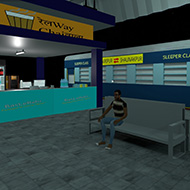
What happens when a tea stall simulator quietly stops being about tea? That’s the question most people land on this page trying to answer, usually right after finishing Railway Chai Wala for the first time and wanting to compare notes on what actually happened at Fakripur station.
| Genre | Psychological Horror / Simulation |
| Playable Character | Ramu |
| Setting | Fakripur railway station |
| Release | November 2025, free to play |
| Player Reception | Very Positive, 96% of user reviews |
Every session of Railway Chai Wala starts the same unassuming way: you crack the gas valve under Ramu’s stall, wait for the blue flicker to catch, and set the first pan of milk on to heat while a loudspeaker somewhere down the platform announces a train that hasn’t actually arrived yet. There’s no cutscene explaining the stakes and no menu dump of lore — the game just puts your hands to work immediately, which is part of why the eventual shift into horror lands as hard as it does.
For the first several minutes, Railway Chai Wala plays exactly like its screenshots promise. You’re brewing chai, frying samosas, and handing bottles of Kokila Cola to tired passengers moving through Fakripur on their way to somewhere else, and the game gives you just enough time settling into that rhythm that the routine starts to feel automatic rather than tense.
That opening stretch is doing more work than it looks like. By the time anything unusual happens, the player has already internalized which sounds belong at Fakripur station and which don’t, so the game never needs to explain what’s wrong — it only needs to break a pattern the player has already learned without realizing it.
The turn isn’t loud. It’s a passenger who orders the same thing twice, a train announcement that repeats a name it already used, a customer whose face you don’t quite remember serving a minute ago even though the game insists you did. None of it is spelled out, and that ambiguity is a big part of what players end up debating once the credits roll — whether the horror in Railway Chai Wala is something happening to Fakripur station itself, or something happening to Ramu specifically.
Newer players sometimes mistake the early wrongness for a bug rather than a deliberate cue, which means they miss the first genuine warning sign the game gives them. That confusion is common enough that it’s become a recurring topic in early reviews, with several players admitting they replayed the opening shift once they realized the repeated announcement wasn’t a glitch at all.
Careful players tend to start cross-referencing which passengers repeat and which don’t fairly early, treating each shift almost like a puzzle rather than a straightforward service loop. That habit tends to reward them once the game starts layering in passengers whose orders subtly contradict something they said a shift earlier, a detail easy to miss if you’re focused purely on keeping the chai brewing on schedule.
Chai brewing is the game’s central verb, and it stays mechanically relevant even after the horror elements take over — timing the milk, managing the stove, and balancing orders under a growing sense of unease is a genuinely different kind of tension than a jump-scare-driven game would offer. The stove itself never gets more complicated in a technical sense, but the number of things competing for Ramu’s attention around it steadily increases, which is how the game raises difficulty without ever changing its core controls.
Players who lean into optimizing their service speed early on tend to notice the environmental changes faster, simply because their attention isn’t fully absorbed by the cooking loop the way a slower, more cautious player’s would be. Meanwhile, players who prefer to take the tea-brewing at face value and treat Railway Chai Wala purely as a relaxing simulation often miss the earliest cues entirely, which changes how abruptly the horror elements seem to hit them later on.
By the time you’re several shifts deep and frying samosas has become second nature, the game starts layering in small inconsistencies around the station that reward players who’ve been paying attention to the mundane details all along — a stacked crate that’s moved slightly, a regular passenger who no longer greets Ramu by name, a Kokila Cola bottle sitting on the counter that nobody ordered.
Community vocabulary around Railway Chai Wala tends to circle a handful of recurring phrases — “the loop,” referring to the repeating train announcement, and “Fakripur logic,” a half-joking term for how the game bends its own rules once the horror sets in. Both terms show up constantly in discussion threads from players trying to piece together whether specific shifts are meant to be read literally or symbolically.
Reviews describe finishing the game as leaving them with goosebumps and, more than once, with a genuine lesson about kindness and responsibility toward the people passing through Ramu’s stall regardless of circumstance. That emotional throughline is part of why the game’s reception stays largely positive even among players who found the middle stretch slow, since the payoff tends to reframe the earlier cooking-sim pacing as necessary rather than padded.
Not every player finds the pacing works for them. Some reviews note that the early cooking-sim minutes run a little long before the tension actually kicks in, which is a fair critique for anyone expecting the horror elements immediately rather than letting the mundane routine set them up. It’s a divisive enough point that it shows up in nearly every longer review, even the overwhelmingly positive ones.
Kokila Cola: the bottled soda Ramu sells alongside chai and samosas, and one of the small recurring details players use to track whether a given shift is behaving normally or not.
Whether or not the horror in Railway Chai Wala is meant to be read literally, the answer most players settle on has less to do with solving Fakripur station’s mystery outright and more to do with noticing how much of it was visible in Ramu’s daily routine from the very first pan of milk.