


Cat Coffee Shop
Tomodachi Life: Living the Dream

Joy Pony

Game of Farmers

Life The Game

Good Coffee, Great Coffee

Cinema Simulator















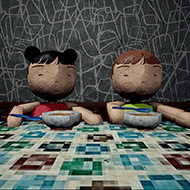


What actually happens when you fumble a five-second microgame in Meteor 60 Seconds? You do not just lose points. You lose the character tied to that scene, and getting them back means grinding through the same rotation of tiny challenges again until the game deals you another shot.
| Genre | Microgame Collection |
| Total Microgames | 82 |
| Zones | Dumbville, Dumbgypt, Dumb Peak, Dumbtune |
| Goal | Collect characters and unlock the ending video |
The core of Meteor 60 Seconds is a rotating pool of 82 microgames, each lasting only a handful of seconds and testing a completely different reflex than the one before it. One prompt might ask you to tap in rhythm, the next to drag an object out of danger, the next to avoid tapping at all. The rotation is randomized enough that memorizing a fixed order does not work, which keeps reaction speed relevant even after dozens of runs.
Every successful microgame adds a new character to your collection for the train station being rebuilt across the game’s four zones, and every failure risks losing whichever character was tied to that specific scene, giving each attempt real stakes beyond a simple score counter.
The zones you unlock, Dumbville, Dumbgypt, Dumb Peak, and Dumbtune, each bring a different visual theme and a new slice of the microgame pool into rotation. Reaching a new zone in Meteor 60 Seconds is less about narrative progression and more about content variety, since the desert setting of Dumbgypt and the frosty summit of Dumb Peak pull from noticeably different scenario types than the earlier stages do.
New players tend to react on instinct without reading the on-screen prompt first, which backfires constantly since several microgames intentionally invert the expected response. A scenario that looks like it wants a tap sometimes actually wants you to hold still, and players who fire off a reaction before the prompt fully registers lose characters to scenes they would have cleared easily with half a second more patience.
The other common mistake is chasing every zone at once instead of clearing a manageable rotation first. Meteor 60 Seconds rewards familiarity with a smaller pool of microgames before diving into zones that mix in scenarios you have never seen.
Players split fairly evenly between two goals. Some treat every run as a leaderboard attempt, optimizing for the highest possible score and accepting character losses along the way as an acceptable cost. Others play more conservatively, prioritizing keeping every character alive across a run specifically to unlock the game’s ending music video reward, even if that caution costs them a higher score.
That split is one of the more common things players discuss when comparing strategies, since the two approaches genuinely call for different play styles rather than one simply being the correct way to play.
Losing a character to a microgame you genuinely did not understand in time rarely feels unfair for long, since the same scenario tends to reappear within a run or two, and recognizing it the second time is usually enough to clear it cleanly. That quick feedback loop, fail once, learn the prompt, succeed next time, is a big part of why Meteor 60 Seconds stays engaging well past the first hour.
Meteor 60 Seconds never slows down long enough to feel repetitive, and that pace is exactly what makes losing a character sting and recovering from it satisfying in equal measure. By the time Dumbtune’s zone finally opens up, reading a prompt correctly in under a second stops feeling like luck and starts feeling like a skill you actually built.