


Cat Coffee Shop

Tomodachi Life: Living the Dream

Joy Pony

Game of Farmers

Life The Game

Good Coffee, Great Coffee

Cinema Simulator























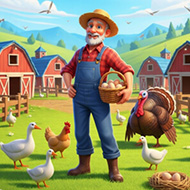
You crouch beside the second pen just as the sun clears the barn roof, and one of your hens is standing over a fresh egg like she’s daring you to take it. That small moment is basically the whole pitch of Eggstreme Farming — check a pen, take an egg, notice the water trough is getting low, move on before the next bird finishes laying. Nothing about that first morning feels dramatic, and that’s the point: the game trusts you to notice the chores stacking into a routine rather than announcing it with a tutorial popup every few minutes.
| Genre | Farming simulator |
| Perspective | First person |
| Animals | Chickens, ducks, geese, turkeys |
| Core loop | Feed, water, collect, sell |
Every new save drops you into the same modest setup: one pen, a handful of chickens, and a vending machine that hasn’t recorded a single sale yet. There’s no second pen waiting behind a menu unlock — you can’t buy a duck or expand until you’ve proven the first pen can run without falling apart, and that ceiling is deliberate rather than a placeholder left in by accident. It forces you to learn the feed-water-collect rhythm on a small, forgiving scale before the game hands you anything more complicated to manage.
Progress ties into a license system, and licenses come from experience earned through daily tasks: collecting a set number of eggs, selling full trays, keeping animals fed and medicated on schedule. Completing those tasks consistently is what actually unlocks the second pen, not simply playing for a certain number of in-game days, so a player who ignores medicine and water refills can stall out well past when a more attentive player has already expanded. New players tend to overfeed on the first day, dumping resources into troughs before they’ve learned how fast each species actually consumes food, which wastes money that would otherwise go toward the second pen’s setup cost.
The day-and-night cycle matters more than it looks. Chickens lay on their own internal schedule, not on command, so standing next to a hen and waiting does nothing — players who treat the cycle as background flavor instead of a scheduling tool tend to waste entire mornings camping a pen that isn’t going to produce anything for another in-game hour. Completionist-minded players in particular gravitate toward mapping out exactly when each species lays relative to the day-night cycle, since shaving those gaps down is one of the few ways to meaningfully speed up early progression.
Chickens, ducks, geese, and turkeys each need their own pen setup rather than acting like reskins of each other, and medicine only becomes relevant once a bird’s health actually dips — you have to notice the problem before it worsens instead of letting an unhealthy animal keep producing at a reduced rate. Geese and turkeys in particular consume feed at a noticeably faster rate than chickens, which is part of why jumping straight to the larger species before the economy can support them is one of the more common ways a new farm stalls out.
By the time you’re running two pens with different feed types, the routine stops being intuitive and starts being an actual schedule you have to hold in your head. Players who lean into that logistics side — the ones treating Eggstreme Farming almost like a spreadsheet problem — tend to describe the payoff differently than more casual players who just want to wander pen to pen at their own pace, and both approaches are valid ways to play once the second pen opens up.
Eggs don’t sell individually in Eggstreme Farming. They get gathered by hand into trays and carried to the vending machine, which turns collection into a small logistics puzzle once more than one pen is active at a time — you’re no longer just gathering eggs, you’re deciding how many trips a full trays run is worth against the time spent topping off water and food elsewhere.
Laying runs on the bird’s own timer tied to the day-night cycle, not player input, so a hen that hasn’t laid yet simply hasn’t reached her window. Some testers have also reported chickens freezing in place and refusing to lay until the save is restarted from the main menu, which is a known bug tracked by the developers rather than something you’re doing wrong in your feeding or watering routine.
The current demo caps players at two pens and two feed types, a restriction meant to show the core loop without revealing the full scope planned for the eventual full release. Several automation systems referenced in early livestream footage, including an automatic egg collection machine, aren’t accessible in the demo build at all.
No — trays are the actual sales unit, and eggs get carried to the vending machine as a batch rather than sold from inventory one by one. This is part of why players who let eggs pile up unsold inside pens instead of moving them into trays regularly end up wasting storage capacity they didn’t need to lose.
Eggstreme Farming currently reads as an early build rather than a finished simulator, and that’s worth saying plainly instead of glossing over. Some testers have reported GPU usage spiking hard even at the lowest graphics settings, with temperatures climbing well past what other games on the same hardware produce, and the absence of a proper frame rate cap in the demo is the specific technical complaint driving most of that discussion. Community discussion also circles back to the mid-game stretch feeling repetitive once the starting upgrades are bought and the next automation tier hasn’t opened yet — a fair complaint for a genre built on repetition in the first place, and one the developers themselves have acknowledged is a balance issue they’re still working through between demo builds.
None of that erases what already works. The core rhythm of feeding, checking water, collecting, and selling holds together even in a limited demo state, and the version currently public is already a noticeable improvement over the pre-alpha build shown in early livestreams, with smoother progression pacing than what testers described in that earlier footage.
Save compatibility is another thing worth flagging honestly: progress made in the demo does not carry over into the full version once it releases, so anything built up now is effectively a trial run rather than a head start.
Eggstreme Farming is, for now, a small and unglamorous idea executed with more care than its rough edges suggest, and the vending machine sitting empty on day one is the same machine you’ll be restocking constantly by the time a second pen full of geese and turkeys is running alongside your original flock of chickens.