


Cat Coffee Shop
Tomodachi Life: Living the Dream

Joy Pony

Game of Farmers

Life The Game

Good Coffee, Great Coffee

Cinema Simulator






















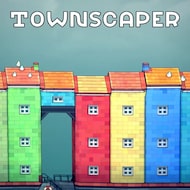
What happens when a city-building game removes objectives, resources, failure conditions, and traditional progression systems? Townscaper answers that question by focusing almost entirely on creativity. Instead of managing economies or balancing statistics, players place colorful building blocks into the sea and watch entire neighborhoods emerge automatically. The result feels less like a strategy game and more like a digital toy designed for experimentation.
| Genre | Creative Building Sandbox |
| Main Focus | Town Construction |
| Setting | Procedural Island Grid |
| Core Activity | Building Structures |
The core mechanic revolves around placing colored blocks on a grid positioned above the water. Every placement automatically generates walls, roofs, stairs, gardens, archways, or towers according to underlying procedural rules. Players do not construct individual architectural elements directly. Instead, they influence the system and observe how it responds.
New players are often surprised by how quickly complex structures appear. A handful of placements can generate entire streets, bridges, and plazas without requiring manual construction.
The game encourages experimentation because mistakes carry no consequences. Any structure can be modified or removed instantly.
Creative players frequently spend hours testing unusual shapes, while casual players often enjoy simply watching buildings emerge from the water.
One of the most enjoyable aspects involves uncovering procedural features hidden within the building system. Certain arrangements create staircases, while others generate courtyards, balconies, or covered walkways. These details appear naturally when specific patterns form.
Community discussions often use the term “happy accidents” when describing unexpected architectural results. Many of the most impressive towns begin as simple experiments rather than carefully planned projects.
By the time larger settlements emerge, players start recognizing how the system interprets different shapes. Understanding those patterns allows much greater control over final results.
A common criticism involves the lack of traditional objectives. Some players appreciate the complete freedom, while others eventually wish for additional challenges or structured goals.
Color selection significantly influences the atmosphere of a town. Different palettes can transform the same structure into something that feels like a coastal village, an island fortress, or a dense urban district.
Early creations often focus on individual buildings. Later projects usually emphasize entire skylines and waterfront layouts. The scale naturally expands as players become more comfortable with the building system.
Organic growth is a phrase frequently used by the community because towns often develop gradually rather than according to strict blueprints.
A recognizable moment for longtime players occurs when a small cluster of buildings unexpectedly forms a beautiful courtyard or bridge without deliberate planning.
Despite having no economic systems, quests, or progression trees, the game maintains long-term appeal through creativity. Every session can produce a completely different settlement depending on the shapes and colors chosen.
Design-oriented players often recreate real architectural styles, while experimentation-focused players test unusual formations simply to see how the procedural rules react. Both approaches reveal new possibilities within the system.
Another frequently searched question involves whether there is a final objective or ending. The answer is no. The reward comes from creating structures and discovering new design possibilities rather than reaching a specific conclusion.
Vertical construction emerges naturally when blocks are stacked in specific configurations. Experimenting with narrow foundations and layered placements often produces tall structures with unique architectural details.
Individual sections can be removed and rebuilt at any time. This flexibility encourages experimentation because redesigning entire districts remains simple even after extensive construction.
Many procedural details only appear when certain layouts are created. Staircases, courtyards, arches, and bridges often emerge from specific building patterns. Discovering these combinations forms a major part of the game’s appeal.
Townscaper remains memorable because every structure emerges from a simple interaction between player choices and procedural architecture. Whether creating towers above the water, experimenting with colorful skylines, or discovering unexpected courtyards, Townscaper transforms a handful of building blocks into surprisingly beautiful towns.